🧬 Single-Cell Drug Response Prediction
A User-Intent Guided Repository (2021-2025)
Navigating the landscape of computational pharmacology. Whether you need zero-shot prediction on unseen cell types, mechanistic pathway interpretation, or large-scale screening simulations, find the right AI tool for your specific biological question.

球探报告写得再好,也要上过场才算数。
Predicting a cell's drug response is a scouting problem. Nobody has seen this tumour play — but the tape library is full: thousands of bulk cell-line games with measured outcomes (GDSC, CCLE). 球探的工作不是背下每场比分,而是把录像压成一份在没见过的对手身上也站得住的报告。

🎾 The Draft Board: A Scouting Cycle in Six Reports
「不看他训练,只看他打没打过这种对手。」
A drug-response model is a scouting department: it files reports on players (drugs, cell lines) it has measured, then stakes its reputation on players it has never seen — your single cells. Six reports from the scouting cycle, re-read as the concepts this module's methods formalize.
Training on measured panels
Every scouting department starts with tape: thousands of completed games, each with a final score. GDSC and CCLE are that library — bulk cell lines, each with measured IC50 or AUC for every drug on the shelf.
Training data. You learn from what has already been measured: bulk panels with known drug outcomes. Everything else is extrapolation.
Transferable signatures
Nobody scouts by re-watching every tape. You write the one-page report: speed, spin tolerance, weakness on the backhand — the few numbers that predict the rest.
Feature compression. Distil panels into drug-signature enrichment (beyondcell) or a shared latent space (scDEAL) — a report that travels, not a memory of every score.
Domain adaptation
A report written on the college league needs translation before the pros: different ball, different pace, different lights. Bulk-to-single-cell is the same trip — dropout, depth, and dynamic range all change the reading.
Align the domains. SCAD aligns bulk and single-cell adversarially; scDEAL's DaNN learns the transfer explicitly. Without it, the report misreads the league.
Prediction with uncertainty
Draft night arrives and the kid has never faced a pro serve. You submit the report anyway — with a confidence note attached, because the honest scout prices what he hasn't seen.
Prediction ≠ certainty. Applying to single cells means scoring a player never faced. Report uncertainty; a confident number without provenance is a rumor.
False positives & validation
Every scout has one: the can't-miss prospect who misses. In our game the bust is the cell called "resistant" that was merely cycling, low-depth, or missing from the training panel — a label error, not biology.
Validate before you sign. A "resistant" call can be a technical artifact. Check against observed response — and remember cross-league transfer can collapse (r = 0.83 in-panel to r = 0.21 out).
Provisional by design
Three matches in, the report gets revised: the backhand weakness was real, the serve was underrated. Good scouts rewrite — the report is a living document, not a verdict.
Update against observation. Compare prediction with observed response and revise. A scouting report is written in pencil; so is every drug-response score.
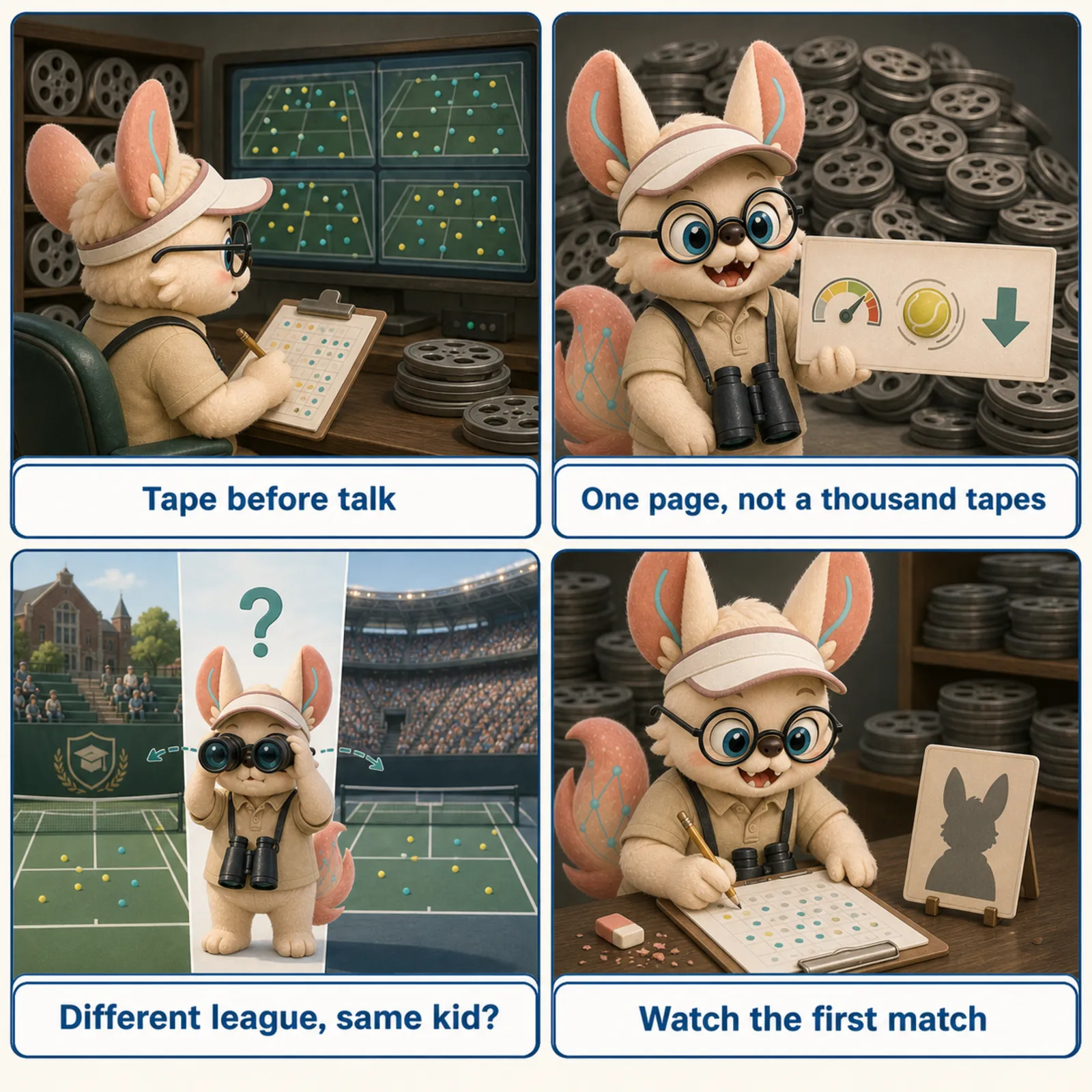
「球探报告永远写在铅笔里——上过场,再改。」 — every score is a draft, every observation an editor.
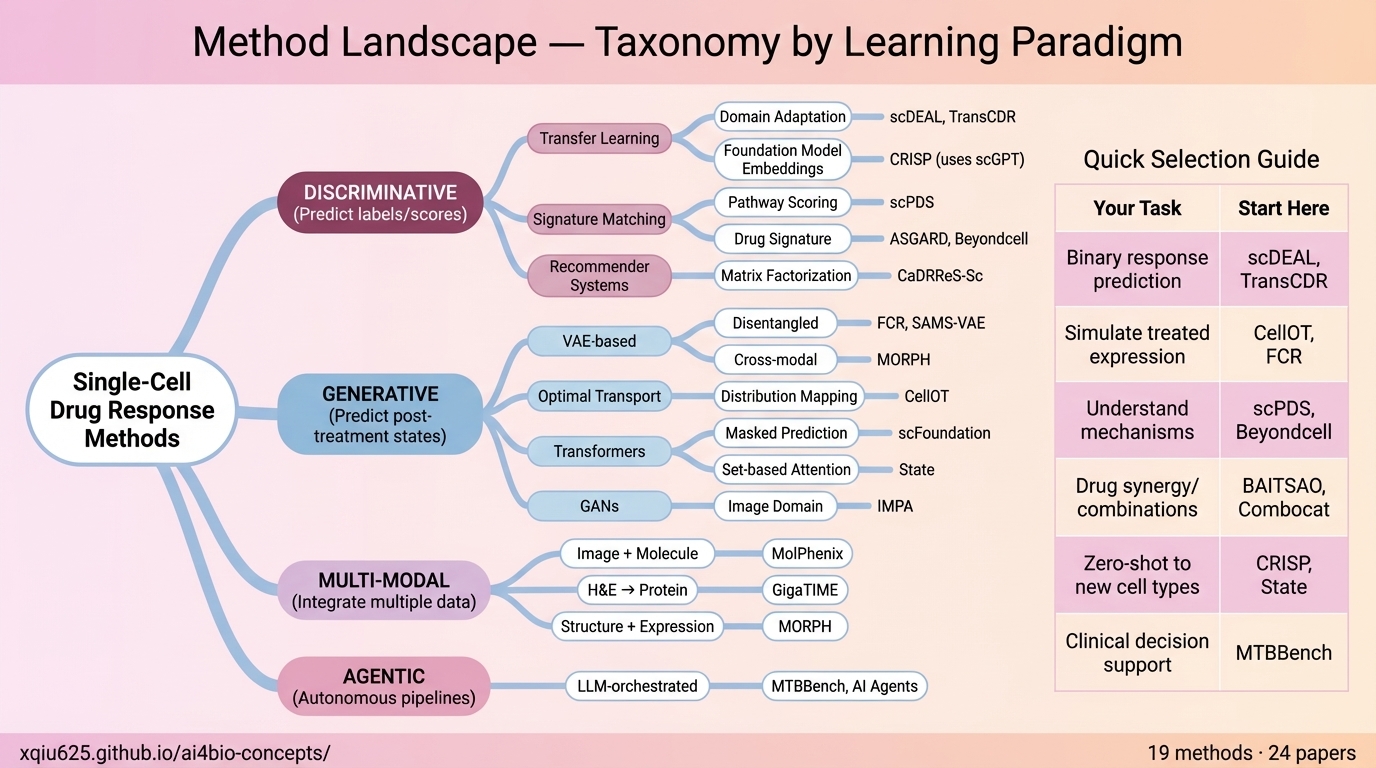
🎮 Concept: The Perturbation Vector
Before exploring specific tools, visualize the core challenge: moving a cell from a "Control" state to a "Treated" state. Modern AI methods (like CRISP) learn this vector field in high-dimensional space, while methods like State account for resistant subpopulations.
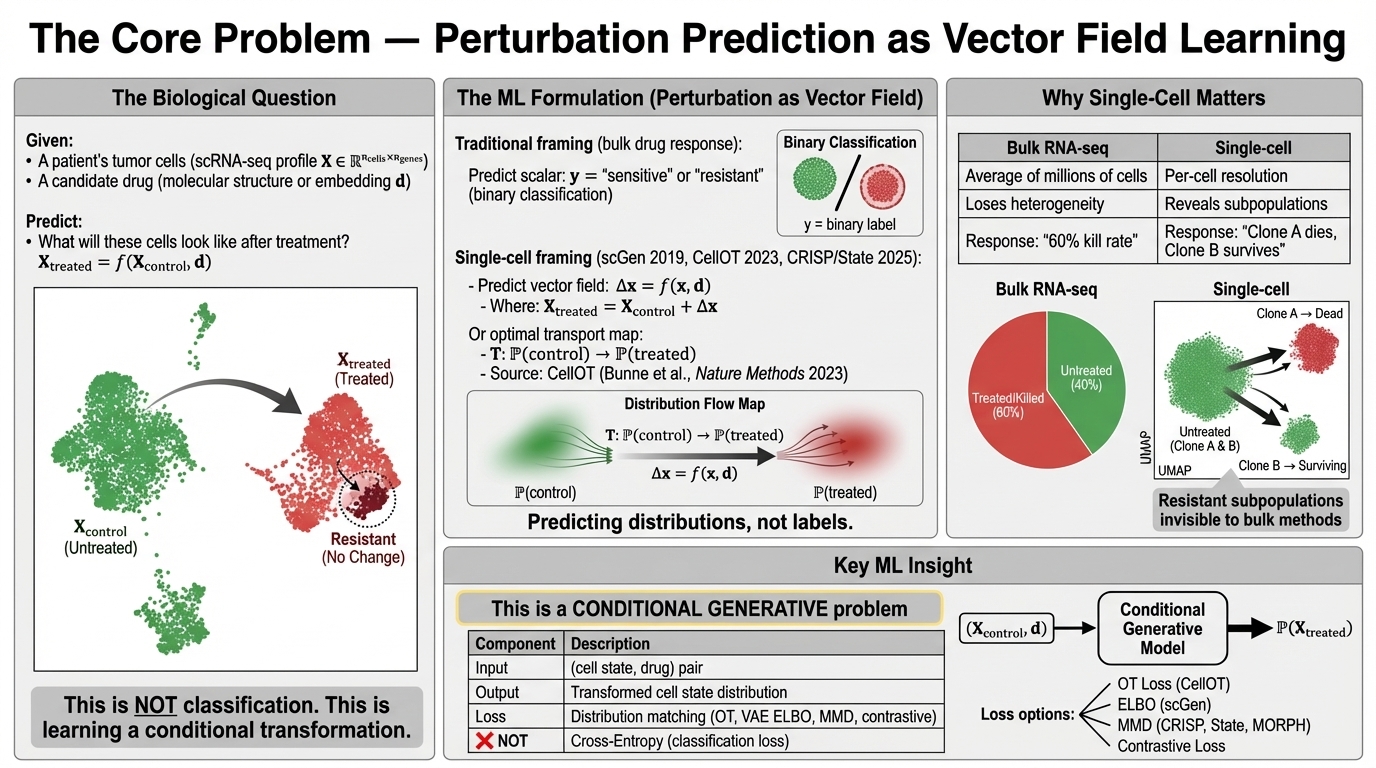
🚀 Foundation Models & Transfer Learning
CRISP
Uses embeddings from large foundation models (like scGPT) to enable zero-shot prediction of drug responses in unseen cell types. It maps perturbation effects across different cellular contexts.
State
A general-purpose Transformer trained on 100M+ cells. Uses set-based attention to model how entire populations of cells shift states under perturbation, rather than just single cells.
scFoundation
Large-scale pre-trained model on 50M+ cells using xTrimoGene architecture. Offers zero-shot capabilities for various downstream tasks, including drug response classification.
TransCDR
A deep learning model for cancer drug response prediction that transfers knowledge from bulk RNA-seq cell line data to single-cell patient data.
scDEAL
Deep transfer learning framework that integrates bulk and single-cell RNA-seq to predict cancer drug responses, harmonizing feature spaces between the two modalities.
🧪 Generative Perturbation (The "What If" Engines)
CellOT
Uses Neural Optimal Transport to learn a mapping between untreated and treated cell populations. Unlike standard style transfer, it respects the mathematical geometry of the cell state space.
FCR
Factorized Causal Representations. A VAE that disentangles cell identity from treatment effects, allowing for the generation of "counterfactual" single-cell states (e.g., "What if this specific cell had been treated?").
IMPA
Generative model for morphological perturbations. Uses style transfer GANs to predict how cell shape and structure change under chemical or genetic perturbation from microscopy images.
SAMS-VAE
Sparse Additive Mechanism Shift VAE. Models perturbation effects as sparse, additive shifts in latent space. Enables interpretable and composable predictions for drug combinations.
🧬 Mechanism & Interpretability
scPDS
Transforms gene expression into pathway activation scores before processing. Uses self-attention to capture interactions between biological pathways, offering high interpretability.
scGSDR
Gene semantics-based profiling. It integrates cellular states with signaling pathways to identify interpretable resistance phenotypes rather than just black-box probabilities.
scDrug+
Matrix factorization and SVM with molecular fingerprints show superior performance. Published in Biomedicine & Pharmacotherapy.
🎯 Synergy, Prioritization & Screening
BAITSAO
Unified drug synergy model powered by GPT-3.5 embeddings. It predicts how two drugs will interact (synergy/antagonism) across hundreds of thousands of combinations.
scDrugPrio
An unbiased cell type-centric framework that prioritizes drugs based on single-cell disease signatures, helping identify candidates for repurposing.
scPharm
Identifies pharmacological subpopulations of single cells to reveal cell-type-specific vulnerabilities, aiding in precision oncology.
ASGARD
Single-cell Guided pipeline to Aid Repurposing of Drugs. Designed to connect cell-specific targets to existing drug databases for new indications.
CaDRReS-Sc
A matrix factorization-based recommender system (like Netflix for drugs) that predicts clone-specific therapeutic vulnerabilities.
DrugReflector
Deep learning ensemble trained on CMap signatures. Uses active reinforcement learning to iteratively refine hit discovery, achieving 13-17× improvement over random screening.
PBMF
Predictive Biomarker Modeling Framework uses contrastive learning to distinguish treatment-specific predictive biomarkers from prognostic markers, improving clinical trial patient selection.
📸 Multi-Modal & Morphological
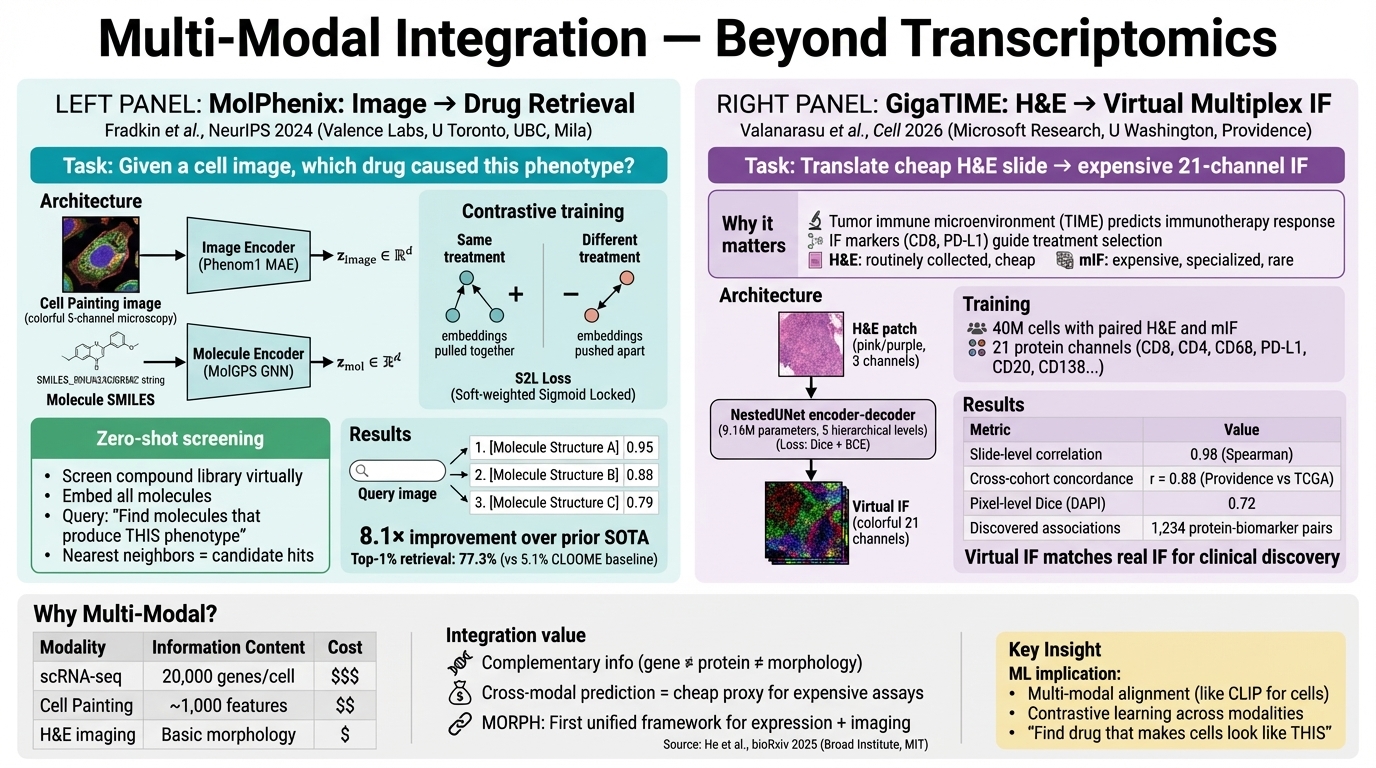
MolPhenix
Contrastive phenomolecular retrieval framework. It matches cell-painting images to molecular structures in a zero-shot manner, enabling virtual screening based on phenotype.
📚 Atlases, Databases & Benchmarks
Tahoe-100M
The largest single-cell perturbation atlas to date (95.6M cells). Profiles 379 drugs across 47 cancer cell lines with 1,138 drug-dose conditions. The "ImageNet" of perturbation biology.
ScDrugAct
A comprehensive database characterizing drug activity at the single-cell level. Useful for retrieving reference activity signatures for specific compounds.
TDC-2
Therapeutics Data Commons 2. The gold standard for benchmarking. Includes specific tasks for single-cell drug target identification and perturbation prediction.
🤖 AI Agents & Clinical Decision Support
Agentic AI in Drug Discovery
Comprehensive review of LLM-based agents with perception, computation, action, and memory tools. Documents case studies compressing drug discovery workflows from months to hours.
🧫 Experimental Platforms & Translational Tools
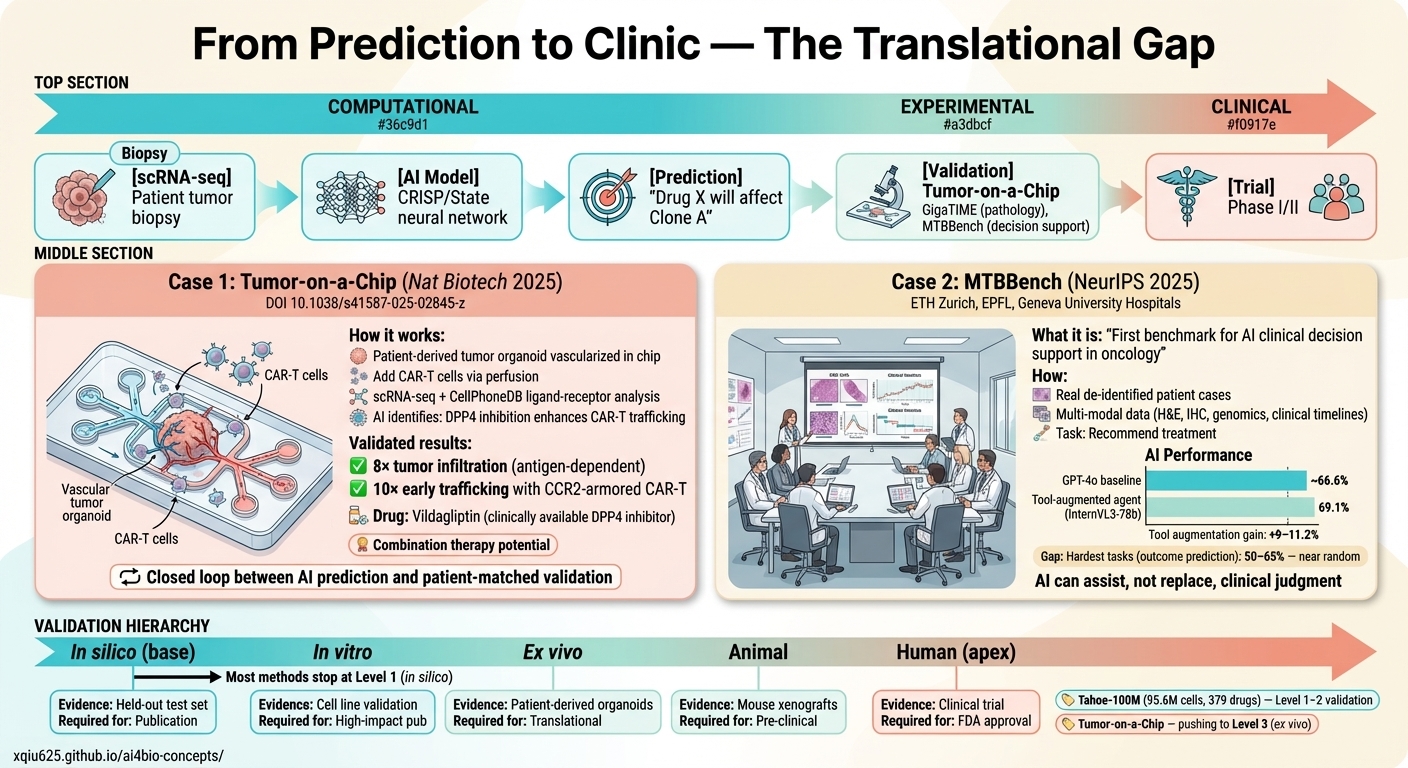
● Computational: scRNA-seq → AI Model (CRISP/State) → Prediction ("Drug X will affect Clone A")
● Experimental: Two validation case studies — Tumor-on-a-Chip (Nat Biotech 2025) enhances CAR-T trafficking 8× through DPP4 inhibition (vildagliptin) via CXCR3-CXCL10/11 axis; MTBBench (NeurIPS 2025) benchmarks AI clinical decision support showing tool-augmented agents reach 69.1% accuracy (+9–11.2% gain).
● Clinical: Phase I/II trials — the validation hierarchy from in silico (publication) through in vitro, ex vivo, animal models, to human trials (FDA approval).
Current frontier: Tahoe-100M (95.6M cells, 379 drugs) and Tumor-on-a-Chip pushing methods to Level 2–3 (ex vivo).
Tumor-on-a-Chip for CAR-T
Microengineered tumor-on-a-chip enabling vascularized human tumor explants and CAR-T cell perfusion. Identified DPP4/CXCR3 axis as combination therapy target via ligand-receptor analysis.
🛠️ Hands-On Practice
The walkthrough below takes a QC'd tumour AnnData object all the way to a per-cell drug-sensitivity readout, along the two routes the field actually uses. Path A is training-free: score every cell against a curated drug signature collection (the beyondcell SSc/PSc idea, run here with decoupler in Python). Path B is the bulk-to-single-cell transfer route made popular by scDEAL and SCAD: train a sensitivity model on GDSC/CCLE cell-line expression with measured IC50 labels, then move it onto unlabelled single cells with an explicit domain-adaptation term. Everything is computational and retrospective — no assay is run, and every conclusion is a hypothesis to be checked against existing data.
Environment & packages
The Python side (scanpy + decoupler + torch) covers signature scoring and the transfer model. beyondcell itself is an R/Seurat package, so it is installed separately if you want its native SSc/PSc collections and BCS ranking plots; the signature tables it ships can also be exported and consumed from Python.
# conda / mamba recommended
conda create -n scdrug python=3.10 -y
conda activate scdrug

pip install scanpy anndata decoupler
pip install torch --index-url https://download.pytorch.org/whl/cpu   # or a CUDA wheel

# optional: beyondcell (R/Seurat) for native SSc + PSc signature collections
# R: install.packages(c("Seurat", "remotes"))
# R: remotes::install_github("cnio-bu/beyondcell")
Hardware. Signature scoring on ~50k cells against a few thousand drug signatures runs in minutes on a laptop (8–16 GB RAM). The transfer model in Path B is small — a two-layer encoder over a few thousand shared genes — and trains on CPU in under a minute; a GPU only matters if you scale to hundreds of drugs or use a large autoencoder pretraining stage as scDEAL does.
Data structures & formats
AnnData(target domain) — the single-cell object:adata.Xnormalised/log1p expression,adata.obsper-cell metadata,adata.obsmfor the cells × drugs score matrices produced below. No drug labels exist here — that is the whole problem.- Bulk expression matrix (source domain) — GDSC or CCLE cell lines × genes, typically log2 TPM or RMA-normalised microarray. A few hundred to ~1,000 rows only, which is why overfitting is a real risk.
- Drug response table — one row per (cell line, drug) pair with
LN_IC50and/orAUC. Binarising at the per-drug median gives the sensitive/resistant labels used for classification; keeping ln(IC50) continuous turns it into regression. - Drug signature collection — long-format table of
drug, gene, weight. beyondcell's SSc signatures are built from genes that separate sensitive from resistant cell lines; its PSc signatures are the transcriptional changes caused by the drug itself (LINCS L1000 / CMap).decouplerconsumes exactly this long format as itsnet. - Score matrix (BCS-equivalent) — cells × drugs enrichment scores, stored in
adata.obsm["mlm_estimate"]; ranking cells within a drug, or drugs within a cell, is the usual downstream move. - Model artefacts — the shared gene list, the per-domain scaling parameters, and the encoder weights must be saved together. Re-applying a model without the exact gene order and scaler it was trained with silently produces garbage.
Minimal code walkthrough
Path A scores cells against a signature collection with no training at all. Path B trains on GDSC bulk with a held-out cell-line split, then transfers to single cells while an MMD penalty pulls the two domains' latent distributions together — the step that makes bulk-trained weights usable on dropout-heavy, shallow single-cell profiles.
import scanpy as sc
import numpy as np
import pandas as pd
import decoupler as dc
import torch
import torch.nn as nn

# =====================================================================
# PATH A - signature scoring (beyondcell-style): no training required
# =====================================================================

# 1. Load a QC'd tumour object and normalise. Signature scoring expects
#    log-normalised values, NOT raw counts.
adata = sc.read_h5ad("tumor_qc.h5ad")
sc.pp.normalize_total(adata, target_sum=1e4)
sc.pp.log1p(adata)

# 2. Drug signature collection as a long table: drug -> gene -> weight.
#    SSc = genes separating sensitive from resistant cell lines.
#    PSc = genes changed BY the drug (LINCS/CMap perturbation profiles).
#    Restrict to genes actually measured in this dataset, or the scores
#    are diluted by signature members that can never be detected.
sig = pd.read_csv("lincs_drug_signatures.tsv", sep="\t")   # drug, gene, weight
sig = sig[sig["gene"].isin(adata.var_names)]
sig = sig.groupby("drug").filter(lambda g: len(g) >= 15)   # drop thin signatures

# 3. Score every cell against every drug signature.
dc.run_mlm(mat=adata, net=sig, source="drug", target="gene",
           weight="weight", use_raw=False, verbose=True)
bcs = adata.obsm["mlm_estimate"]            # cells x drugs, the BCS analogue
adata.obs["bortezomib_sig"] = bcs["bortezomib"].values

# 4. Immediately ask whether a "resistant-looking" group is real biology.
#    Overlay depth and cell-cycle phase on the same embedding: low-depth
#    or cycling cells routinely masquerade as a resistant subpopulation.
sc.pl.umap(adata, color=["bortezomib_sig", "total_counts", "phase", "leiden"])

# =====================================================================
# PATH B - bulk -> single-cell transfer (the scDEAL / SCAD idea)
# =====================================================================

# 5. SOURCE domain: GDSC bulk cell lines with measured drug response.
#    IC50 is a POPULATION summary - one number per cell line, per drug.
#    There is no per-cell equivalent anywhere in this pipeline.
expr = pd.read_csv("GDSC_expression.tsv", sep="\t", index_col=0)   # lines x genes
resp = pd.read_csv("GDSC_ic50.tsv", sep="\t", index_col=0)["Bortezomib"]

lines = expr.index.intersection(resp.dropna().index)
genes = expr.columns.intersection(adata.var_names)                 # shared features
Xb = expr.loc[lines, genes].to_numpy("float32")
yb = (resp.loc[lines] < resp.loc[lines].median()).to_numpy("float32")  # 1 = sensitive

# 6. TARGET domain: the single cells, same gene order, zero labels.
Xs = adata[:, genes].X
Xs = np.asarray(Xs.todense() if hasattr(Xs, "todense") else Xs, dtype="float32")

# 7. WHY DOMAIN ADAPTATION IS NOT OPTIONAL. Bulk RNA-seq of a cell line and
#    a single-cell profile of a tumour cell do not share a distribution:
#    scRNA has heavy dropout (most genes read as exact zeros), 10-100x lower
#    effective depth, and a compressed dynamic range. A model fit on bulk and
#    applied naively is evaluated far off its training manifold. Per-domain
#    standardisation is the MINIMUM, and is not sufficient on its own.
Xb = (Xb - Xb.mean(0)) / (Xb.std(0) + 1e-6)
Xs = (Xs - Xs.mean(0)) / (Xs.std(0) + 1e-6)

# 8. Held-out split ON THE SOURCE domain, so the bulk model's own skill is
#    measurable before anything is transferred. Split by cell line - never
#    let the same line appear in both halves.
rng = np.random.default_rng(0)
perm = rng.permutation(len(Xb))
cut = int(0.8 * len(Xb))
tr, te = perm[:cut], perm[cut:]

# 9. Shared encoder + sensitivity head. The adaptation term forces the encoder
#    to produce features whose bulk and single-cell distributions overlap.
#    scDEAL uses a DaNN/MMD penalty; SCAD uses an adversarial discriminator.
#    A linear-kernel MMD is shown here for readability.
class Net(nn.Module):
    def __init__(self, p):
        super().__init__()
        self.enc = nn.Sequential(
            nn.Linear(p, 512), nn.ReLU(), nn.Dropout(0.3),
            nn.Linear(512, 128), nn.ReLU(),
        )
        self.head = nn.Linear(128, 1)

    def forward(self, x):
        z = self.enc(x)
        return z, self.head(z).squeeze(-1)

def mmd(a, b):                      # linear-kernel MMD between batch means
    return ((a.mean(0) - b.mean(0)) ** 2).sum()

net = Net(len(genes))
opt = torch.optim.Adam(net.parameters(), lr=1e-3)
bce = nn.BCEWithLogitsLoss()
Xb_t, yb_t, Xs_t = torch.tensor(Xb), torch.tensor(yb), torch.tensor(Xs)

for epoch in range(300):
    net.train()
    bi = torch.randint(0, len(tr), (64,))        # labelled bulk lines
    si = torch.randint(0, len(Xs_t), (256,))     # UNLABELLED single cells
    zb, logit = net(Xb_t[tr][bi])
    zs, _     = net(Xs_t[si])
    loss = bce(logit, yb_t[tr][bi]) + 1.0 * mmd(zb, zs)   # lambda = 1.0
    opt.zero_grad()
    loss.backward()
    opt.step()

# 10. Sanity-check the SOURCE fit first; only then transfer to the cells.
net.eval()
with torch.no_grad():
    _, lo = net(Xb_t[te])
    acc_bulk = ((torch.sigmoid(lo) > 0.5).float() == yb_t[te]).float().mean()
    _, ls = net(Xs_t)
    adata.obs["pred_sensitivity"] = torch.sigmoid(ls).numpy()
print(f"held-out cell-line accuracy: {acc_bulk:.3f}")

# 11. Validation is necessarily INDIRECT - no per-cell ground truth exists.
#     (a) do the two paths agree? (b) are predicted-resistant cells enriched
#     for plausible resistance programmes? (c) does a known-sensitive vs
#     known-resistant cell line pair, pushed through the same model, come
#     out in the expected order?
print(np.corrcoef(adata.obs["pred_sensitivity"], adata.obs["bortezomib_sig"])[0, 1])
sc.tl.rank_genes_groups(adata, groupby="leiden", method="wilcoxon")
sc.pl.umap(adata, color=["pred_sensitivity", "bortezomib_sig", "leiden"])
Common pitfalls & tips
- IC50 has no single-cell ground truth. Every label in GDSC/CCLE is a population-level summary of a bulk viability curve; nothing in a scRNA-seq experiment measures the sensitivity of an individual cell. Per-cell predictions can therefore only be validated indirectly — agreement between independent methods, enrichment of known resistance programmes, or consistency with a downstream clinical/response annotation — never against a per-cell IC50.
- Cell lines do not contain a tumour microenvironment. A model trained on GDSC has never seen stroma, immune infiltrate, hypoxia gradients, or drug-penetration limits. Resistance that is microenvironment-mediated is invisible to it by construction, so restrict scoring to the malignant compartment and do not read the scores of T cells or fibroblasts as drug predictions.
- Batch/domain shift is the dominant error source. GDSC bulk and patient scRNA differ in platform, depth, dropout, and dynamic range at once. Always check that the encoder's latent bulk and single-cell clouds actually overlap (UMAP the latent space, colour by domain); if they sit in separate blobs, the adaptation weight is too low and the transferred predictions are extrapolation.
- Signature collections carry their own context. SSc/PSc and LINCS signatures were derived in specific cell lines at specific doses and time points. A signature built in a haematological line at 10 µM says little about an epithelial tumour at physiological exposure — check the provenance of every collection before interpreting its scores as drug response.
- A "resistant" cluster is often a technical cluster. Low-depth cells score flat on every signature, and cycling cells score high on anything with a proliferation component. Before believing a resistant subpopulation, colour it by
total_counts,n_genes_by_counts, mitochondrial fraction, and cell-cycle phase; regress or stratify if it tracks any of them. - Always run a known-sensitive / known-resistant control pair. Push two cell lines with well-documented, opposite response to your drug through the identical pipeline. If the model cannot separate that pair, its single-cell output is not interpretable — this is the cheapest and most informative sanity check available, and it catches gene-order and scaler mismatches immediately.
- Do not compare raw scores across drugs. Signature scores and model logits are on arbitrary, per-drug scales driven by signature size and label balance. Rank cells within a drug, or z-score each drug across cells, before making any "drug X beats drug Y" statement.