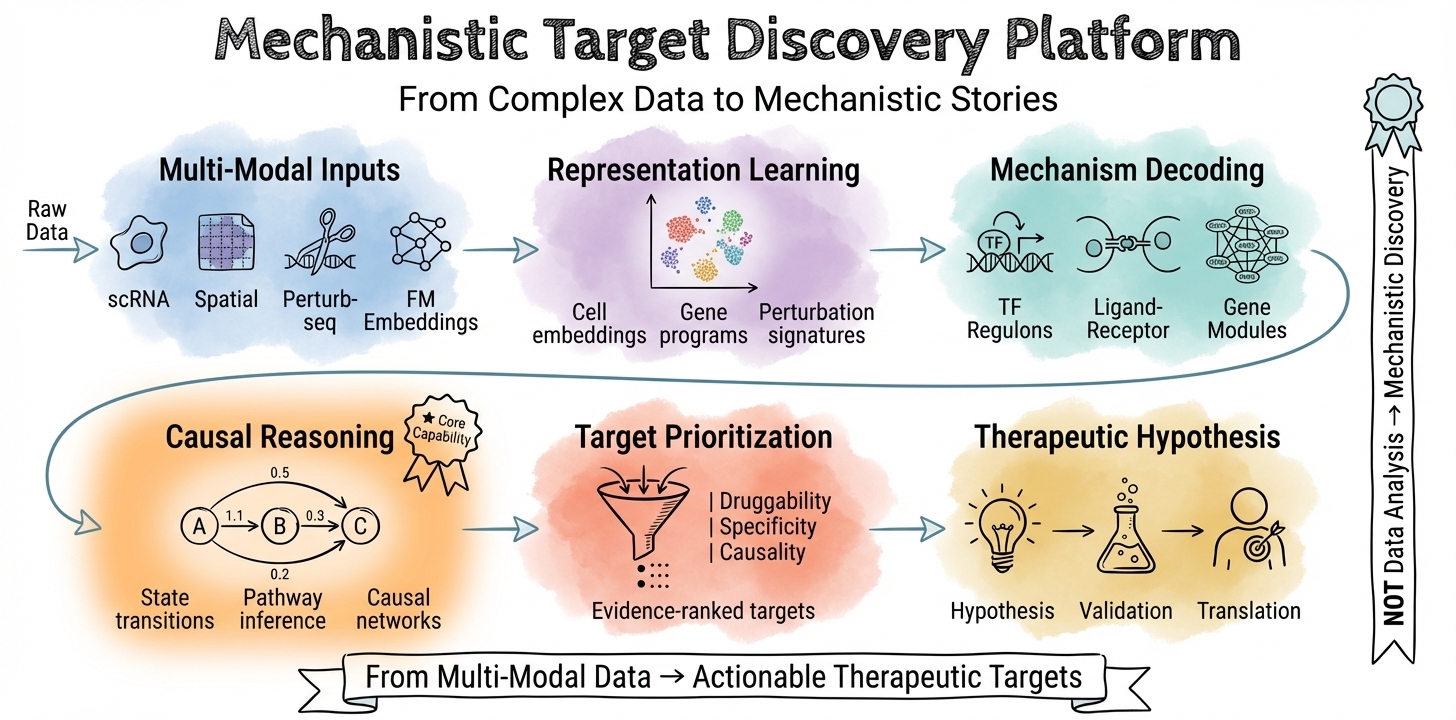
🎯 I leverage foundation models and multi-omic data to uncover disease mechanisms and identify therapeutic targets. My work transforms single-cell, spatial, and perturbation data into mechanistic insights—mapping causal pathways, decoding microenvironments, and prioritizing druggable targets for therapeutic discovery.
🧬 Core Expertise: I specialize in extracting biological meaning from AI model outputs. My background in 🧬 biology, 💊 pharmacology, ⚗️ chemistry, and 💻 computational modeling enables me to translate foundation model embeddings into mechanistic hypotheses and actionable target nominations.
I obtained my PhD in Genetics, Genomics, and Bioinformatics from UC Riverside in 2023, advised by Professor Adam Godzik. Download my one-page resume (full CV available on request).
What I Do
Foundation Model Mechanistic Interpretation Primary
→ Platelet-FM-Benchmark
I extract biological insights from foundation models (STATE, UCE, scGPT, Geneformer, TranscriptFormer) by analyzing attention patterns, embedding structures, and latent representations. My focus is on interpreting what these models learn about gene regulation, pathway activity, and cell state—translating computational outputs into mechanistic hypotheses for target discovery.
Multi-Omic Mechanistic Integration
→ PlateletSubpop-ML
→ sepsis-scrna-dynamics
I integrate single-cell, spatial, and perturbation data to map disease mechanisms. This includes identifying disease-driving cell populations, inferring causal gene regulatory networks, decoding immune microenvironment dynamics, and evaluating target plausibility through cross-modal evidence synthesis.
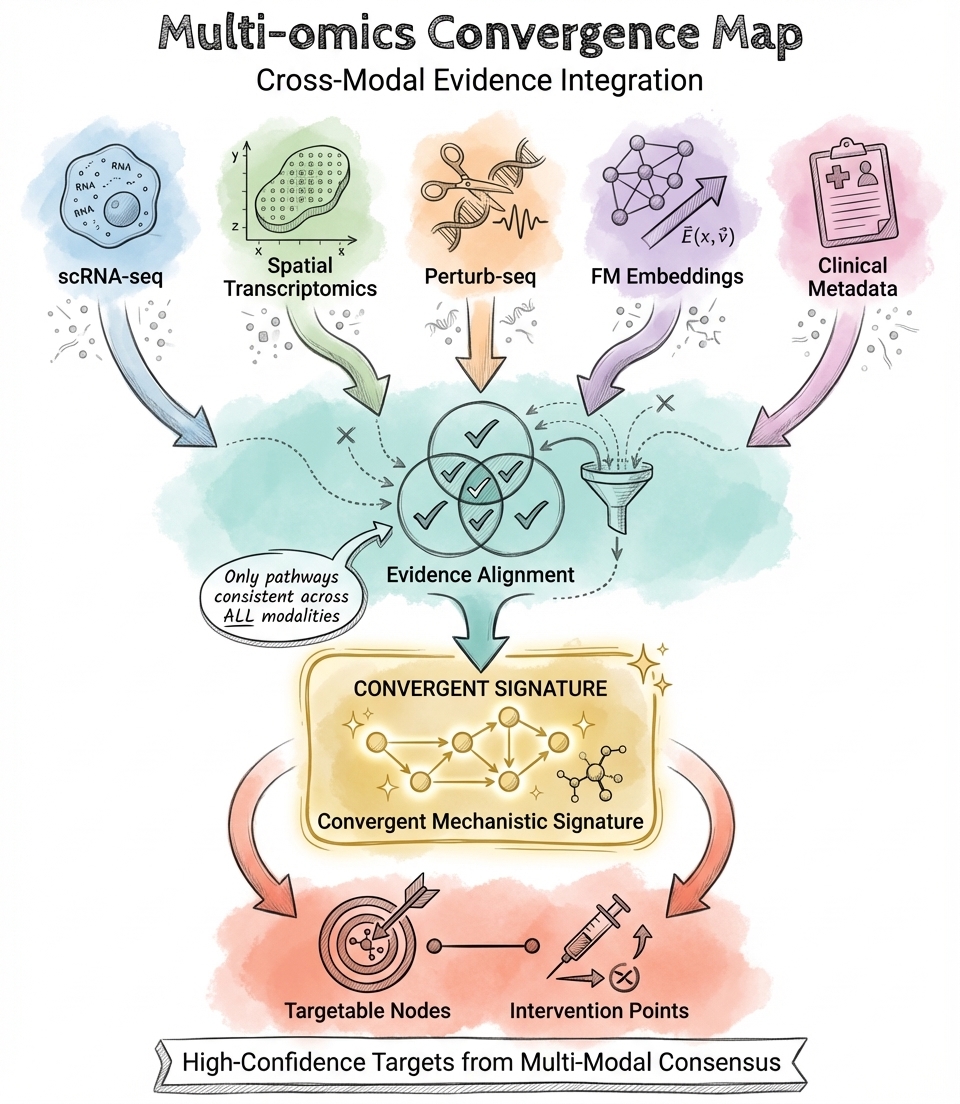
High-confidence targets from multi-modal consensus
Spatial Microenvironment & Target Context
→ spatial-kidney-rejection
→ cardiovascular-proteomics-bioimage
I analyze spatial transcriptomics and imaging-based (Xenium) data to understand how tissue architecture drives disease. This includes mapping spatial niches that harbor disease-relevant cell states, anchoring molecular data to tissue histology, linking ligand-receptor signaling with foundation model embeddings, and identifying microenvironment-dependent therapeutic targets.
Therapeutic Discovery Workflows
I build interpretable computational frameworks that connect AI outputs to therapeutic decision-making—from mechanism-of-disease modeling to target nomination and verification-aware validation—supporting experimental validation and translational research.
Featured Projects
Open-source, documented, and reproducible. Each links to code and methods on GitHub.
Platelet Foundation-Model Benchmark
Out-of-distribution robustness benchmark of five single-cell foundation models (STATE, UCE, Geneformer, scPRINT, scGPT) for infection-severity prediction, with anti-leakage patient-level cross-validation. Released as the scfm-benchmark package.
GitHub → Platelet-FM-Benchmark
Cardiovascular Proteomics & Bioimage
Platelet scRNA-seq ↔ mass-spectrometry proteome integration (Spearman ρ = 0.49, 6,902 genes) and imaging-based Xenium spatial analysis of human carotid atherosclerosis (120,164 cells): neighborhood enrichment, Ripley's K/L, two-panel replication.
GitHub → cardiovascular-proteomics-bioimage
Platelet Subpopulations & ML
Deep neural network and XGBoost models on 47,977 single-cell platelet transcriptomes across COVID-19, sepsis, and SLE, revealing prognostic biomarkers and therapeutic-target modules. First author, Int. J. Mol. Sci. 2024.
GitHub → PlateletSubpop-ML-ScTranscriptomics
Spatial Kidney Allograft Rejection
First spatial transcriptomic (10x Visium) study of kidney allograft rejection; image/histology-anchored spatial analysis identifying FCGR3A-high monocyte/macrophage subclusters in acute rejection. Frontiers in Immunology 2025.
GitHub → spatial-kidney-rejection
Sepsis Single-Cell Dynamics
Single-cell transcriptional dynamics of fatal sepsis, identifying cell-type-specific signatures that distinguish fatal from survival outcomes. Co-first author, J. Leukoc. Biol. 2021 (115+ citations).
GitHub → sepsis-scrna-dynamics
🚀 My Interdisciplinary Journey
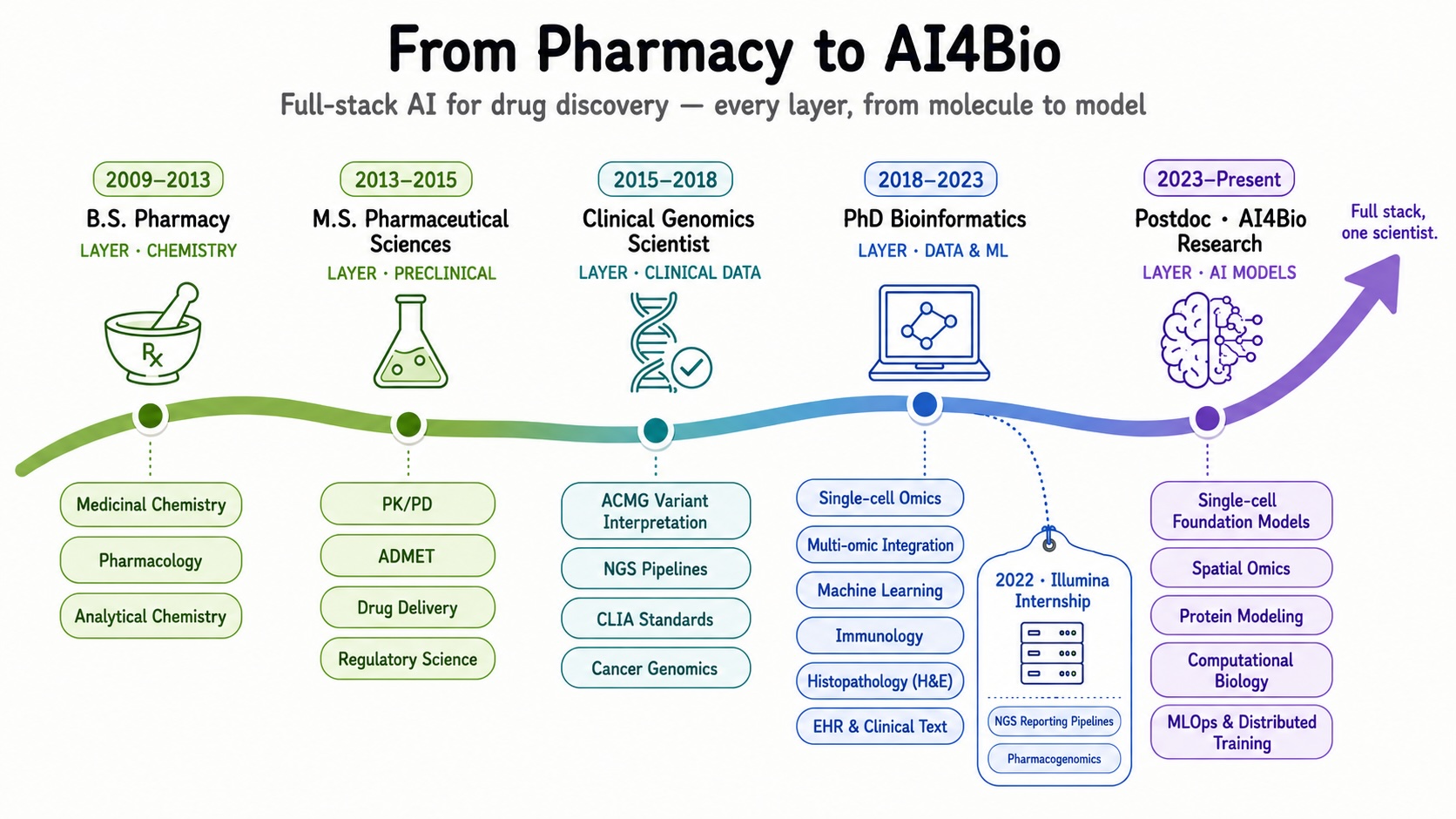
From pharmaceutical sciences to AI-driven target discovery
Let's Connect
Interested in AI-driven target discovery, mechanistic biology, or foundation model interpretation? Feel free to reach out via email or connect on LinkedIn.